Most pool comparisons online were written for a national audience by people who've never seen what 30 freeze-thaw cycles a year does to a buried pool shell. Central Ohio is a harder environment than most pool content acknowledges. The same pool that performs beautifully in Phoenix can crack within a decade in Powell — not because of poor workmanship, but because of the wrong material choice.
This guide is for homeowners weighing fiberglass, concrete (gunite), and vinyl liner pools, written by Maxima Pools — an authorized San Juan dealer that has installed fiberglass pools across Columbus, Delaware, Dublin, Westerville, and the surrounding counties, and serviced concrete and vinyl pools we didn't build. We'll cover real numbers — installation cost, 20-year cost of ownership, maintenance hours per week — plus what to look for in a pool that has to survive an Ohio winter.
Quick Answer
For Central Ohio's climate, fiberglass is the best long-term choice for the majority of homeowners.
- Lowest 20-year cost of ownership of the three options
- No re-plastering or liner replacement — both major recurring costs of the alternatives
- Flexes with ground movement instead of cracking under freeze-thaw stress
- Installs in 3–5 days instead of 8–12 weeks for concrete
- Lower-maintenance surface — typically 30–40% less chemical use than concrete
The honest case against fiberglass is shape and size limits — shells are pre-molded, so if you want a pool larger than 16'×45' or with custom geometry, concrete is your only option. For backyards in Franklin, Delaware, Union, and Licking counties — where most installations fit standard fiberglass dimensions — that limit rarely matters.
Browse the full collection of San Juan models we install, or book a free consultation to talk through your specific yard.
The Three Pool Types — At a Glance
Each of these has fans, valid use cases, and well-documented failure modes. Here's the honest summary.
Concrete (Gunite / Shotcrete)
A steel rebar cage sprayed with concrete, then plastered or tiled. Fully custom shapes and sizes — from a 60-foot lap pool to an infinity edge with a vanishing horizon. Installation takes 8–12 weeks with multiple weather-dependent cure stages. The plaster surface is porous, which means more chemicals to fight algae and resurfacing every 10–15 years at $6,000–$15,000 per cycle.
In freeze-prone climates, the rigid shell has nowhere to go when ground frost expands underneath. Cracking is statistically inevitable; the question is when and how bad. Most concrete pools in Ohio show their first repair-grade cracks within 12–18 years.
Vinyl Liner
A steel or polymer wall framework holding a vinyl liner stretched and locked at the deck. Cheapest upfront — typically $30,000–$50,000 fully installed. Installs in 2–4 weeks. Smooth surface, flexible to a few semi-custom shapes.
The killer is the liner itself. It tears, fades, and ages out in 7–10 years. Replacement runs $4,500–$8,000. Pets, pool toys, sun exposure, and the wrong chemical balance all shorten its life. Over 20 years of ownership, you'll replace the liner two to three times. Sharp objects through a liner are also a same-day emergency — the pool can drain enough to threaten the wall structure within hours.
Fiberglass
A pre-molded one-piece shell with multiple layers of hand-laid woven fiberglass and a gel-coat surface, dropped into a prepared excavation. Standard sizes from compact spas up to 16'×45'. Install window: 3–5 days from delivery to swimming.
The shell is engineered to flex — small movements absorb without cracking, similar to how a boat hull handles wave stress. The non-porous gel-coat fights algae naturally and never needs resurfacing. The trade-off is shape: you pick from manufacturer molds, you don't draw from scratch.
For Central Ohio, the math is rarely close.
Why Ohio's Climate Is Brutal on Pools
The single biggest factor most national comparisons get wrong is freeze-thaw cycling.
Columbus averages 30–40 freeze-thaw cycles a year — every time the temperature crosses 32°F up and down, ground moisture expands and contracts. Each cycle puts pressure on whatever's buried in your yard. A rigid concrete pool shell sitting in clay soil gets squeezed every winter, and clay holds water like a sponge.
Concrete cracks under repeated stress. The damage is invisible at first — hairline fractures behind the plaster. By year 12–15, the cracks have widened enough that water leaks through, you notice the bill creeping up, and you're staring at a $4,000–$8,000 repair quote.
Fiberglass shells flex by 1–2% under load — barely perceptible visually, but enough to absorb the soil movement that destroys concrete. Same reason the marine industry uses fiberglass for boat hulls: water and ground pressure aren't constant, and rigid materials lose to flexible ones over time.
This isn't a minor edge case. Anyone who's owned a concrete pool through 15 Central Ohio winters has a repair history. We've quoted dozens of those repairs on pools we didn't build. See how we approach Freezable Pools — fiberglass shells engineered specifically for this climate.
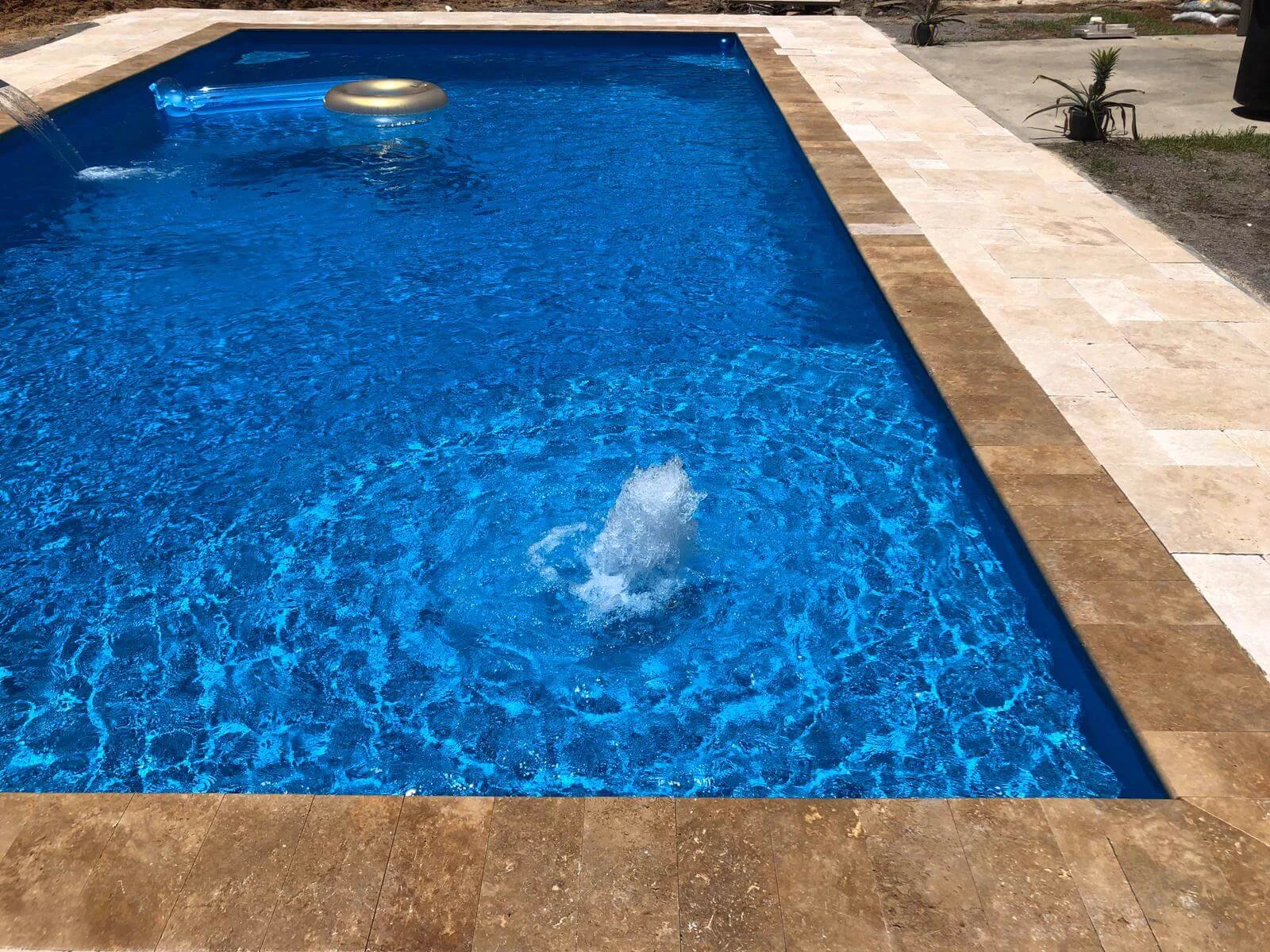
A 14'×30' San Juan fiberglass pool installed in Central Ohio. The gel-coat surface is smooth and non-porous — algae doesn't anchor to it the way it does to concrete plaster.
20-Year Cost of Ownership
Sticker prices favor vinyl. Total cost of ownership tells a different story. Here's a realistic 20-year accounting for a mid-size pool in Central Ohio (assumes a 14'×28' or equivalent).
| Cost item | Concrete | Vinyl Liner | Fiberglass |
|---|---|---|---|
| Initial install | $65,000–$95,000 | $30,000–$50,000 | $55,000–$85,000 |
| Re-plaster / liner replacement | $12,000 (2×) | $14,000 (2.5×) | $0 |
| Annual chemicals (20 yr) | $14,000 | $10,000 | $8,000 |
| Annual heating (20 yr) | $18,000 | $17,000 | $14,000 |
| Average crack/leak repairs | $5,000 | $1,500 | $500 |
| 20-year total | $114,000–$144,000 | $72,500–$92,500 | $77,500–$107,500 |
Vinyl wins on raw 20-year cost only at the bottom of its range, and only if you're lucky on liner life. Once you factor in the inconvenience cost — pool out of commission for liner replacement, pets that puncture, fade and staining — fiberglass closes the gap or beats it for most owners.
Concrete is the most expensive option by a wide margin. Beautiful, fully custom, and the right answer for the small percentage of buyers who genuinely need shapes fiberglass can't offer.
Lyon Financial offers terms up to 30 years on fiberglass installs — for many homeowners the monthly payment difference between fiberglass and vinyl is smaller than expected.
Maintenance Reality
The maintenance gap between fiberglass and the alternatives is the part most homeowners don't appreciate until they own the pool.
Concrete (plaster surface):
- Brushing weekly is mandatory — algae anchors to the porous surface
- Higher chlorine demand year-round
- Annual acid wash often recommended
- Time on maintenance: ~3–5 hours per week in season
Vinyl liner (smooth but stretches):
- Watch for tears, especially at corners and ladder mounts
- Liner stains permanently from leaves, metals in the water, sunscreen residue
- Replace every 7–10 years
- Time on maintenance: ~2–3 hours per week
Fiberglass (gel-coat surface):
- Smooth and non-porous — algae has nothing to anchor to
- Brushing biweekly is enough
- Lower chlorine demand
- Time on maintenance: ~1–2 hours per week
Multiplied over a season (20–25 weeks of active swim time), the difference is real. Fiberglass owners get back 30–60 hours a year of weekend time, plus several hundred dollars in chemical savings.
Installation Timeline and Disruption
For most homeowners, the installation experience matters as much as the pool itself.
- Concrete: 8–12 weeks. Multiple visits from multiple crews. Yard tear-up between cure stages. Weather-dependent — a wet spring can push completion into August.
- Vinyl: 2–4 weeks. Fewer cure stages, but still meaningful disruption.
- Fiberglass: 3–5 days from shell delivery to swimming-ready. Yard restoration in week two. We've completed full installs in Powell, Worthington, and New Albany over a single school spring break.
That speed isn't a marketing claim — it's the natural result of factory pre-fabrication. The shell shows up cured and ready. We dig, set, plumb, backfill, and concrete the surround. Done. See our process step by step.
What Separates a Quality Fiberglass Shell
If you decide fiberglass is right, the brand and construction method matter enormously. Two shells that look identical from the dealer floor can have a 20-year lifespan difference.
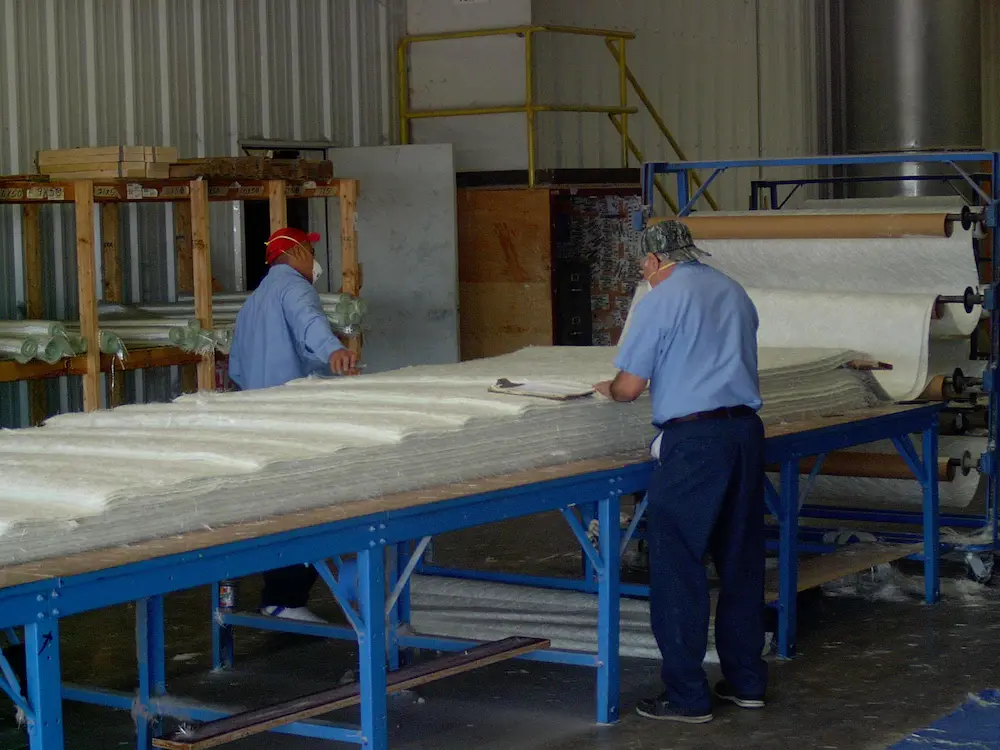
Hand-laid woven roving at the San Juan factory. Continuous strands instead of spray-on chopped fiber — the same technique used on aerospace and marine hulls.
What to look for:
- Hand-laid woven roving — continuous strands of fiberglass woven together, applied by hand, not sprayed by a chopper gun. Hand-laying creates uniform thickness and eliminates the thin spots that fail first.
- Vinyl Ester resin through the entire shell, not just the outer gel-coat layer. Vinyl Ester shares the same chemical backbone as marine epoxy and is genuinely waterproof. Polyester resin (cheaper, used by lower-end manufacturers) absorbs water over time and is the biggest cause of osmotic blistering on aging fiberglass shells.
- Multiple structural layers — at least five hand-laid layers per shell, with structural ribs reinforcing the walls without adding deadweight.
- A real warranty — not just "structural" with eight pages of exclusions. Read what's actually covered, for how long, and what voids it.
We install San Juan Pools exclusively because they meet all four standards better than any other manufacturer we've evaluated. Hand-laid construction, full Vinyl Ester laminate, structural warranty. See exactly how San Juan pools are made, or compare San Juan against competitors.
Common Questions
How long do fiberglass pools last in Ohio?
A properly installed San Juan fiberglass shell is engineered to outlast the house — the structural warranty is for life. The gel-coat finish typically looks new for 20–25 years and can be refinished if it dulls. Cheaper polyester-resin shells (not what we install) often blister within 8–15 years.
Are fiberglass pools good for cold climates?
Yes — better than concrete in cold climates, in fact. The shell flexes with freeze-thaw movement instead of cracking. Pools stay full through winter (water level lowered just below the skimmer), and the shell structure is protected by the water itself. Learn about our Freezable Pools approach.
What's the average cost of a fiberglass pool in Columbus?
Most installations in Central Ohio land between $55,000 and $85,000 fully installed, including pool, plumbing, electrical, basic patio, and equipment. Pricing varies with shell size, patio extent, additional features (auto cover, heater, lighting), and site conditions. Lyon Financial offers terms up to 30 years for qualified buyers.
Can you finance a fiberglass pool?
Yes. We partner with Lyon Financial — terms up to 30 years with rates that often beat home equity lines. Approval typically takes one business day. See current financing options.
Are there any downsides to fiberglass pools?
Two real ones. First, shape limits — you choose from manufacturer molds, you can't custom-draw a unique outline. Second, delivery requires truck access — if your backyard has tight access through a side gate, the install gets more complex (we work around this regularly with cranes when needed).
Does Maxima Pools install concrete or vinyl pools?
No. We install San Juan fiberglass exclusively. The reason is honest: it's the product we believe in installing for our own families. We don't subcontract concrete or vinyl work — better to recommend a different installer than do work outside our standard.
What's the warranty on a Maxima Pools installation?
The San Juan structural warranty is for life on the shell. Maxima's installation workmanship carries its own warranty on the work we perform — plumbing, electrical, concrete surround, and equipment startup. Specifics depend on the installation; we walk through the full warranty package during the consultation.
Ready to Compare Real Models?
The right next step is seeing how specific pool models fit your specific yard. Our Pool Simulator overlays San Juan models on a photo of your backyard so you can visualize size and placement before you commit to anything.
If you'd rather skip ahead to numbers and a real estimate, book a free consultation and we'll walk your space, talk through models that fit, and give you a real quote with no pressure.
See our full pool collection · Read customer reviews · See areas we serve across Central Ohio